

Visual Environmental Supports
This is
an alternate version of the characteristics overview chart on the next
page. It is provided for accessibility.
Verbal
skills
• Nonverbal
• Mixed
• Verbal
Grade
Level
• PK
• Elementary
Cognitive
Level
• Classic
• High Functioning
Areas
Addressed
• (Pre)Academic/Cognitive/Academic
• Adaptive Behavior/Daily Living
• Behavior
• Communication/Speech
• Social/Emotional
Visual
Environmental Supports
Verbal Skills
7 Nonverbal
7 Mixed
7 Verbal
|
Grade Levels 7 PK
7 Elementary
7 Middle/High
|
Cognitive Level
7
Classic
… High
Functioning
|
Areas Addressed 7 (Pre)Academic/ Cognitive/Academic 7 Adaptive Behavior/
Daily Living
7 Behavior
7 Communication/Speech
7 Social/Emotional
|
Brief Introduction
Children with autism (AU) interact with the
environment differently than others due to their challenges in social
interaction, behavior, communication, and sensory processing.This section
includes reviews of 10 environ- mental support
strategies designed to accommodate needs in these areas, (a) visual schedules,
(b) task cards, (c) people locators, (d) boundary
settings, (e) labels, (f) lists, (g) graphic organizers, (h) reminder cards,
(i) travel card strategy, and (j) home base card.
Description
Visual schedules.
Visual schedules are an
environmental support that accommodates the need for predictability and
decreases anxiety about the unknown.Visual schedules take an abstract concept
(i.e., time) and present it in a more concrete and manageable form using
words and/or pictures.They serve two major purposes: (a) to provide motivation by
making clear when preferred activities, tasks, or classes will occur and allow
anticipation of upcoming events and activities; and (b) to facilitate an
understanding of time and the ability to predict change (Myles, 2005).

From Henry,
S. Used with permission.
Visual schedules can be created to present a range of
information, such as a daily schedule, a schedule of activities to be completed
in a class period, and so on.The information listed in each schedule should vary
according to the individual’s age and level of functioning.They may be
presented through written words, objects, photographs, line
drawings, symbols or a combination of these options.Visual schedules can be
displayed in different settings and made of different sizes according to their
purposes.
The decision on (a) what and how the information will
be presented on the visual schedule and (b) where the visual schedule will be
displayed should be based on the specifi c
individual’s characteristics and preferences. In addition, it is important to
ensure that the individual understands the information presented on his visual
schedule.
Task cards. Task cards, typically presented on
business-card-size stock, help children recall academic content, routines, or
social skills by setting out the steps to be followed.The statements are
directives pre- sented in short and concise
language.The content of a task card may be an overview of routines, an out- line of the working schedule, a list of the teacher
expectations, and an outline of communication starters.

From Henry,
S. Used with permission.
People locators.
Children with AU have a strong need
for predictability and often feel anxious about the unknown.Therefore, knowing
where important people in their lives are at various times is important for
many. Any
changes in “who will be where” can create immense anxiety for the child and may
cause the child to display disruptive behaviors if he is unprepared.
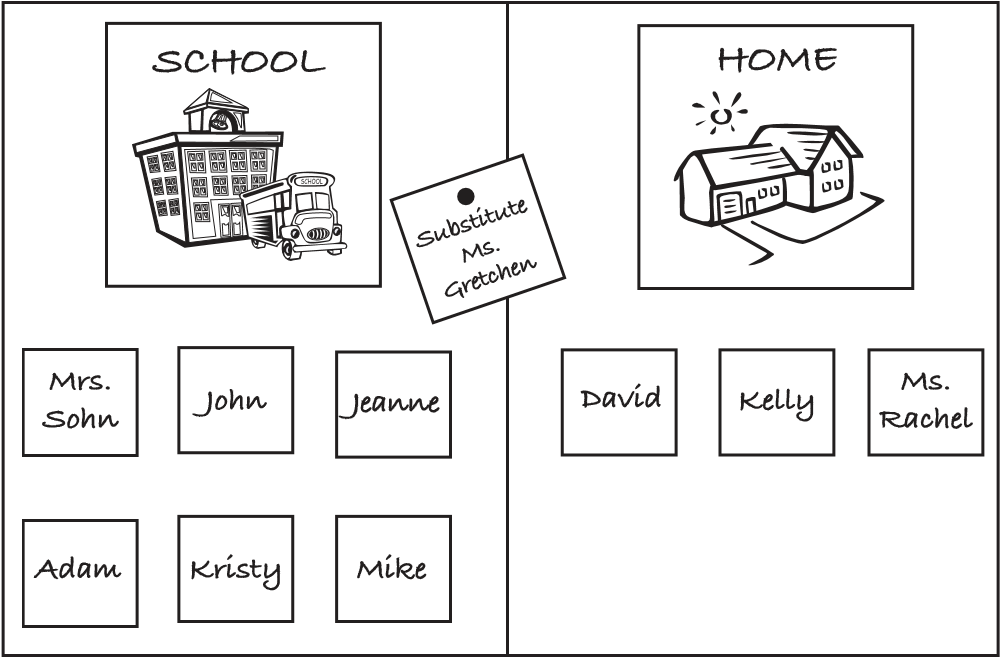
A people locator is a visual support strategy that
provides information about where people are in a visual format that is easily
understood by the child. Specifi cally, a
people locator gives the child information about (a) who is here today, (b) who
is gone today, (c) who is coming later, (d) when someone will come, and (e) where
someone is.
Boundary
settings. A boundary setting is an
intervention that creates structure and helps children with AU manage their own
behavior. Boundary settings provide visual cues that can be used to guide
individuals with AU through physical spaces within their environment. Specifi cally, the purposes of boundary settings are to (a)
provide a safe environment, (b) create structure, (c) establish clear, concise,
and consistent guidelines for behavior, and (d) teach children how to set their
own boundaries in different settings.

From Ahlers,
M., & Zillich, C. H. (2008). Classroom and
communication skills program: Practical strategies for educating young children
with autism spectrum and other developmental disabilities in the public school
setting. Shawnee Mission, KS:Autism Asperger Publishing Company. Used
with permission.
Barriers, rugs, bookcases, furniture, or tape on the fl oor are examples of how to create boundary
settings.There are fi ve
steps in setting boundaries.
1. Address the need . Prioritize the
child’s need.“Does the child have dif fi culty
staying in one place?” “Does the child have diffi culty
in transition from one place to another?” “Does the child have trouble
sitting?” and “Does the child experience problems leaving others’ belongings
alone?” are questions that need to be addressed.
2. Defi ne the boundary . Set up and organize the
classroom into various areas: play area, group area, work area, and quiet area.
Defi ning the boundary will assist children in
understanding areas that are accessible and where things belong. It makes it easier
for children to identify the meaningful parts of the environment.
3. Teach the boundary .Teach how to
recognize and follow the guidelines established by boundary settings.
Modeling and reinforcement are strategies that work
well in teaching children the boundary.
4. Evaluate success. Several questions need
to be answered in evaluating the boundaries you set up: (a) Does the child
independently leave objects where they belong? (b) Does the child consistently
transition successfully from one area to another? (c) Does the child leave
others’ belongings alone? (d) Does the child stay in the designated area? and
(e) Does the child remain seated when desired?

Labels. Labeling is one of the easiest
ways to provide visual supports in the environment. Children with AU fi nd it less stressful and easier to participate effi ciently and function independently in activities
when labels are added to the environment.The following types of labeling can
assist in articulating environmental organization: labeling shelves, draw- ers, and cupboard and closet doors identifi es what and where to fi nd
and return items; labeling an individual’s space and belongings can help
delineate personal possessions; or labeling activity areas, such as the art
table, the play rug, the work table, the leisure area, the break corner, and
the book table. Many children with AU need to be specifi cally taught how to recognize and understand the information
provided by the label.

Lists. Lists
are another valuable way to present information that is typically presented
only verbally (e.g., instruction) or not presented at all (e.g., steps of
taking the school bus) to children with AU (Myles, 2005). Lists allow
individuals with AU to have a solid representation of the information. Lists
may be written in a variety of formats.They can be checklists or numbered
lists of steps to be taken.
Graphic
organizers. The optimal goal of using graphic
organizers is to enhance learning. Graphic organizers, such as semantic
maps,Venn diagrams, outlines, and charts, are visual supports that
organize content material in a way that makes it easier to understand.They are
valuable tools for helping students with AU organize important information
about a topic since they provide visual and holistic representations of facts
and concepts and their relationship within an organized framework.
From The
Geneva Centre for Autism
Reminder cards. (www.autism.net).
Used with permission.
Reminder cards are another visual support strategy that can be
used to support children with AU with daily activities.A reminder card is
simply a visual
cue placed on a piece of paper, an index card, or other media (i.e., PDA) that
gives direction.They can be used in a variety of settings and
situations. Use of reminder cards can enhance independence, minimize disruptive
behavior, and improve communication and understanding
of individuals with AU.
From Cardon,T. (2008). Top ten tips
– A survival guide for families with children on the autism spectrum. Shawnee
Mission, KS:Autism Asperger Publishing
Company. Used with permission.
Travel card
strategy. The travel card provides a brief
list of the academic, behavior, and social strategies on which the child is
working, using a gridlike format (Jones & Jones, 2006).The travel card
strategy involves the child carrying the travel card, which is
prepared by his case manager or resource room teacher on a daily basis, from class to
class. Each teacher must sign the card and indicate whether the student is
engaging in the targeted behaviors.The child receives tokens from each teacher
if he carries the card to class and engages in the targeted behavior during the class
period.
The advantages of the travel card lies in the fact that
it not only increases the child’s productive behavior across multiple
environments but also facilitates teacher collaboration and improves
school-home communication (Carpenter, 2001).
From Myles, B. S., & Adreon, D. (2001). Asperger
Syndrome and adolescence: Practical solutions for school success. Shawnee
Mission, KS:Autism Asperger Publishing
Company. Used with permission.
Home
Base
|
Home base card. Children with AU often have diffi culties modulating their behaviors.A home base is a
quiet
and safe place where individuals with AU can go to regain control over their
environment (Myles & Adreon, 2001; Myles & Simpson, 2003). In other
words, a home base allows children with AU to have a designated spot to (a)
plan or review information or (b) cope with stress and behavior challenges
(Myles & Adreon, 2001). In addition, children with AU who are overwhelmed by
sounds, movement, and lighting might benefi t
from a home base (Faherty, 2000).
A home base should be a positive and prosocial
setting. It is not a time-out room nor a place where children can escape from
whatever they were doing before the need for home base occurred.
To benefit from home
base, the student should be taught how to go to home base at a time when he is
not upset or angry.To make the process go smoothly and be as non-intrusive as
possible, the adult rec- ognizes the student
needs to go to home base and places the home base card on the student’s desk as
a prompt to go to home base.
Steps
There are no specific
steps involved in providing environmental supports to children with AU.
Nevertheless, generally, when providing environmental supports, first
evaluate the child’s strengths, interests, goals, and learning style and identify
challenges that need to be addressed. Based on the child’s specific
characteristics, the appropriate environmental support can then be identified.
Brief Example
Maria is a fi rst-grade
student with AU. Maria’s teacher, Ms. Cook, has noticed that Maria has difficulty
remaining seated with her feet on the fl oor
whenever the students are required to work in groups. Sometimes she lies across the table,
the fl oor, or on her chair, and sometimes she
leaves her seat without permission. In addition, she frequently plays with
other children’s belongings or materials.
Ms. Cook decided to use the boundary setting strategy
to help Maria manage her behaviors. She gave Maria a picture of herself sitting
in her chair, her hands in her lap, feet on the fl oor.The
picture was taped to the table to provide Maria with a
visual reminder of classroom expectations. Ms. Cook praised Maria whenever she
observed her sitting quietly in her chair, with hands in her lap and feet on fl
oor. Soon, Maria
began to do a better job of sitting in her seat and showed a greater respect
for her classmates’ belongings.
Summary
The unique characteristics and challenges of children with AU
can be accommodated through various environmental supports. In determining
appropriate environmental supports for the child, it is important to keep in
mind that those supports should be individualized to meet the specific strengths, challenges, interests, goals, and
learning style of the child.
Research Table
# of Studies
|
Ages
(years)
|
Sample Size
|
Area(s)
Addressed
|
Outcome
|
30*
|
3-Adult
|
119
|
Problem
behavior, transition, communication, social behavior, leisure activities, daily living skill, vocational
skill
|
+
|
*Note:
Includes studies cited in integrated reviews of literature conducted by
Wheeler, Baggett, Fox, & Blevins (2006) and Odom, Brown, Frey, Karasu,
Smith-Cantor, & Strain (2003).
Studies Cited in the Research Table
1.
Ganz,
J. B., Bourgeois, B. C., Flores, M. M., & Campos, B.A. (2008). Implementing
visually cued imitation training with children with autism spectrum
disorders and developmental delays. Journal of Positive Behavior Interventions, 10, 56-66.
The
study investigated the impact of a multicomponent visually cued imitation
strategy. Four children with AU participated. Results revealed a positive
impact of the strategy.
2.
Ganz,
J. B., & Flores, M. M. (2008). Effects of the use of visual strategies in
play groups for children with autism spectrum disorders and their peers. Journal of Autism and Developmental
Disorders, 38, 926-940.
The study investigated the effects of
visual strategies on three children with AU and their peers during play group
sessions. Results revealed positive impacts on the participants’ use of script
phrases, context-related comments, and intervals in which speech occurred.
3.
Vacca,
J. J. (2007). Incorporating interests and structure to improve participation of
a child with autism in a standardized assessment:A case study analysis. Focus on Autism and Other
Developmental Disabilities, 22, 51-59.
The
study described an innovative approach that includes incorporating interests
and a structured schedule, to assess a girl with AU. Results showed positive
outcomes of using the approach.
4.
Brown,
K. E., & Mirenda, P. (2006). Contingency mapping: Use of a novel visual
support strategy as an adjunct to functional equivalence training. Journal of Positive Behavior
Interventions, 8,
155-164.
The study evaluated the effectiveness
of contingency mapping, a new visual support strategy designed to enhance understanding
of the contingencies associated with functional equivalence training.A
13-year-old adolescent with AU participated. Results showed that
contingency mapping was related to reductions in problem behavior and increases
in alternative behavior.
5.
Wheeler,
J. J., Baggett, B.A., Fox, J., & Blevins, L. (2006).Treatment integrity:A
review of intervention studies con ducted with autism. Focus on Autism and Other
Developmental Disabilities, 21, 45-55.
This
study consisted of a search of intervention studies in AU from 1993 to 2003 to
determine treatment integrity. Among the 60 studies located, 15
focused on visual strategies.
6.
Conroy,
M.A.,Asmus, J. M., Sellers, J.A., & Ladwig, C. N. (2005).The use of an
antecedent-based intervention to de crease stereotypic behavior in a
general education classroom:A case study. Focus on Autism and Other Developmental Disabilities, 20, 223-230.
The study evaluated the effectiveness
of an antecedent-based intervention, including the use of visual cues to
indicate activity time, on the stereotypic behavior of a 6-year-old boy with
AU. Results revealed a decrease in the boy’s stereotypic behavior.
7.
O’Reilly,
M., Sigafoos, J., Lancioni, G., Edrisinha, C., & Andrews,A. (2005).An
examination of the effects of a class room activity schedule on levels of
self-injury and engagement for a child with severe autism. Journal of Autism and Developmental
Disorders, 35,
305-311.
The study examined the effects of an
individualized schedule on levels of engagement and self-injury for a
12-yearold boy with AU. Results indicated that a schedule of activities
produced substantial reductions in self-injury and increase in engagement.
Maintenance of the results was documented in the follow-up assessment.
8.
Johnston,
S., Nelson, C., Evans, J., & Palazolo, K. (2003).The use of visual supports
in teaching young children with au tism spectrum disorder to initiate
interactions.
Augmentative and Alternative Communication, 19, 86-103.
This
study involved three boys with AU who were taught to utilize a graphic symbol
representing “Can I Play?” to request entrance into play activities. Results
indicated that the strategy was effective.
9.
Odom,
S. L., Brown,W. H., Frey,T., Karasu, N., Smith-Cantor, L. L., & Strain, P.
(2003). Evidence-based practices for young children with autism:
Contributions for single-subject design research. Focus on Autism and Other
Developmental Disabilities, 18, 166-175.
An
analysis of single-subject design research with children with AU published
between 1990 and 2002 was undertaken. Seven of the 37 studies used visual
supports.
10. Schmit, J.,Alper, S., Raschke, D.,
& Ryndak, D. (2000). Effects of using a photographic cueing package during
routine school transition with a child who has autism. Mental Retardation, 38, 131-137.
The study examined the effi cacy of using a photographic cue
package to teach a young child with AU to make successful transitions in daily
routines across three different school settings. Results indicated that a
combination of verbal and photographic cues reduced the participant’s
tantruming while increasing the number of successful transitions. Several other
positive outcomes were also documented.
References
Brown,
K. E., & Mirenda, P. (2006). Contingency mapping: Use of a novel visual
support strategy as an adjunct to functional equivalence training. Journal of Positive Behavior
Interventions, 8,
155-164.
Carpenter,
L. B. (2001).The travel card. In B. S. Myles & D.Adreon (Eds.), Asperger Syndrome and adolescence:
Practical solutions for school success (pp. 92-96). Shawnee Mission, KS:Autism Asperger Publishing
Company.
Conroy, M.A.,Asmus, J. M., Sellers, J.A., & Ladwig, C. N. (2005).The
use of an antecedent-based intervention to decrease stereotypic behavior in a
general education classroom:A case study. Focus on Autism and Other Developmental Disabilities, 20, 223-230.
Faherty C. (2000). What does it mean to me? A workbook explaining self-awareness and life
lessons to the child or youth Interventions
with high functioning
autism or Asperger’s. Arlington,TX: Future Horizons.
Ganz, J. B., Bourgeois, B. C., Flores, M. M., & Campos, B.A. (2008).
Implementing visually cued imitation training with children with autism spectrum disorders and developmental
delays. Journal of Positive Behavior
Interventions, 10, 56-66.
Ganz,
J. B., & Flores, M. M. (2008). Effects of the use of visual strategies in
play groups for children with autism spectrum disorders and their peers. Journal of Autism and Developmental
Disorders, 38, 926-940.
Johnston,
S., Nelson, C., Evans, J., & Palazolo, K. (2003).The use of visual supports
in teaching young children with autism spectrum disorder to initiate
interactions. Augmentative and Alternative
Communication, 19,
86-103.
Jones,V. F., & Jones, L. S.
(2006). Comprehensive classroom management:
Creating positive learning environments for all students (8th ed.). Boston:Allyn & Bacon.
Myles, B. S. (2005). Children and youth with Asperger
Syndrome: Strategies for success in inclusive settings. Thousand Oaks, CA: Corwin Press.
Myles,
B. S., & Adreon, D. (2001). Asperger Syndrome and adolescence: Practical solutions for school success. Shawnee Mission, KS:Autism Asperger
Publishing Company.
Myles, B. S., & Simpson, R. L.
(2003). Asperger Syndrome:A guide for
educators and parents (2nd ed.).Austin,TX: Pro-Ed.
Odom, S. L., Brown,W. H., Frey,T., Karasu, N., Smith-Cantor, L. L., &
Strain, P. (2003). Evidence-based practices for young children with autism:
Contributions for single-subject design research. Focus on Autism and Other Developmental
Disabilities, 18, 166-175.
O’Reilly, M., Sigafoos, J., Lancioni, G., Edrisinha, C., & Andrews,A.
(2005).An examination of the effects of a class- room activity schedule on levels of
self-injury and engagement for a child with severe autism. Journal of Autism and Developmental
Disorders, 35,
305-311.
Schmit,
J.,Alper, S., Raschke, D., & Ryndak, D. (2000). Effects of using a
photographic cueing package during routine school transition with a child who has
autism. Mental Retardation, 38, 131-137.
Vacca,
J. J. (2007). Incorporating interests and structure to improve participation of
a child with autism in a standardized assessment:A case study analysis. Focus on Autism and Other
Developmental Disabilities, 22, 51-59.
Wheeler,
J. J., Baggett, B.A., Fox, J., & Blevins, L. (2006).Treatment integrity:A
review of intervention studies con- ducted with autism. Focus on Autism and Other
Developmental Disabilities, 21, 45-55.
Texas Autism Resource Guide for
Effective Teaching
Resources and Materials
• Do 2 Learn: www.do2learn.com
This is an extensive resource for
visual supports.
• Interactive Collaborative Autism
Network: www.autismnetwork.org
This learning module provides parents
and educators with a basic understanding of using visual schedules.
• Ohio Center for Autism and Low
Incidence Autism Internet Modules: www.ocali.org/aim
This site
offers a broad range of modules on topics related to AU.You must have a user
account to view mod ules, but the account is free.The
visual support module is thorough and comprehensive.


